5 Ways Smart Student Pilots Cut Their Ground Instruction Bill (and Get More From Every CFI Session)
Flight training has never been more expensive. Between avgas, aircraft rental, and instructor time, a Private Pilot certificate now runs $15,000 to $22,000 for most students, and a big chunk of that is money spent on the ground, not in the airplane.
Here's the part most students don't realize until they're halfway through.
Your CFI is billing you $60 to $90 an hour to sit at a table and explain airspace, weather theory, aeromedical factors, and regulations. Which is fine. That's their job.
But a lot of that time can be replaced by self-study you do at home for $0, and the ground time you do book can be spent on the harder stuff. That's the difference between finishing your certificate on budget and going way over.
I'm an active CFI. The students I've watched finish fastest, and cheapest, all do a version of the same five things. Here they are.
Way 1: They move the "reading and definitions" out of paid instructor time
The most expensive way to learn what Class B airspace is, or what the VFR fuel requirements are for day vs. night, or what the cloud clearance minimums are for Class E below 10,000 feet, is to have a CFI explain it to you at $75 an hour. That is the most costly form of instruction on the market, and it's being used on material that is entirely in the ACS handbook, entirely on YouTube, and entirely coverable by a 10-minute self-study session.
Every hour of ground instruction you spend on the definitional stuff is roughly $75 you could have kept in your training budget for the parts of ground that actually require a human. Scenario walkthroughs, oral prep, cross-country planning review, mock checkrides.
Way 2: They show up to lessons with specific questions, not general confusion
There is a huge difference between a student who walks into ground and says "can we go over airspace?" and a student who walks in and says "I understand Class B and Class C, but I can't figure out when I actually need a Mode C transponder in a Class D. Is that all Class D or only some of them?"
The first student is going to get a 45-minute overview of airspace. The second student is going to get a 5-minute answer to a real question, and then move on to the next thing. One of those students is paying $56 for the answer. The other is paying about $6.
CFI Note: Before every ground session, spend 20 minutes at home going through the material. Write down the 3 or 4 specific things you can't answer. Bring that list. Your CFI will love you for it.
Way 3 :They stay sharp during the inevitable pauses in training
Almost every Private Pilot student pauses at some point. A canceled weekend of weather. A work project. Family stuff. 2 weeks becomes a month becomes 3. This is normal. It's not a character flaw.
What kills students financially is what happens when they come back. If your ground knowledge has decayed, your CFI has to spend the first hour or 2 of every session re-teaching material you already learned. That's real money in re-instruction, per pause, that could have been avoided by 10 minutes a day of retrieval practice during the gap.
What Students Say Once They Fix This
David W, Verified Customer
I use the cards as a measurement for my studying. If I can't answer a question it remains in front of the deck. If I can answer the question it goes to the back. It's a good measure for what I need to keep studying — all in one place, not scattered all over.
Misael, Verified Customer
The flashcards are incredibly well-organized and concise, making it easy to drill the key concepts and procedures.
Jeff V, Verified Customer
The color-coding made it easy to break topics down… and the references to FAR/AIM were super helpful.
Dylan Meade, Amazon Customer
These cards break everything down in a way that’s structured, clear, and practical, not just memorization. The explanations go beyond one-line answers, they actually help you understand the ‘why’.
That's the Reason We Built the Deck
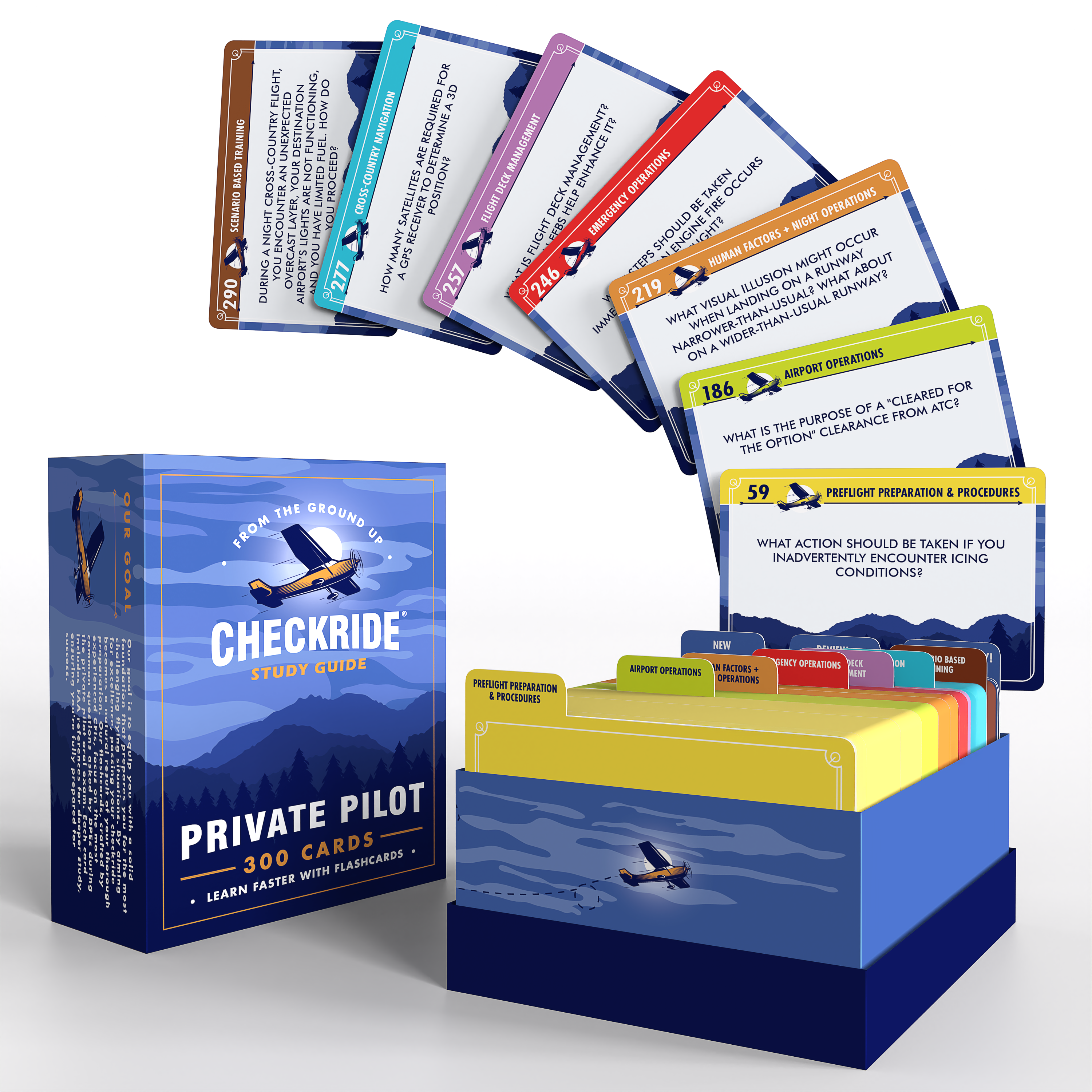
These Private Pilot Flashcards are 308 physical cards, written and reviewed by CFIs, covering the 7 ACS knowledge areas the Private Pilot oral tests. Every card asks a direct or scenario-based question. Every answer cites the FAA reference where the material lives.
The best part?
They cost less than a single flight lesson and are trusted by over 20,000 pilots!
Reason 4: They spend the money on lessons but not on the ground study system
This is the one that separates students who impress their CFI from students who just fill a chair. When you can walk into a lesson and say "I've got airspace memorized, I'm shaky on prog charts, and I don't understand hypoxia or the aeromedical factors yet," you've given your CFI a shot list. They can build the entire session around exactly what you need.
The student who can't do that is essentially paying their instructor to figure out what to teach them. That's a huge amount of the ground instruction on your bill.
CFI Note: When a student shows up with a written list of what they've mastered and what they haven't, my job gets easier and their bill gets smaller. Every CFI I know would prefer this. It's not that students don't want to do it. Most just don't have a system that lets them.
WITH YOUR CFI
ONLY SELF-
STUDY
CFI FOR HARD
STUFF
Way 5: They impress their CFI, which pays off in more ways than the obvious ones
This one is less about money on paper and more about the compounding effect. When a CFI has a prepared student, 3 things happen that most people don't think about.
You get better feedback. A CFI running through a scripted overview for the tenth time this month is not giving you their sharpest analysis. A CFI dealing with a student who is asking real, specific questions is thinking harder, drawing on harder examples, and telling you things they wouldn't otherwise mention.
You get faster stage checks. If your CFI is confident you know your ground knowledge, they will sign you off for stage checks faster. Every week you don't spend waiting for a stage check sign-off is a week you're not paying for the airplane, the schedule, or the delay.
You get flagged for the oral early. CFIs who trust a student's ground knowledge start prepping them for the oral around lesson 10, not lesson 30. That means when the checkride actually comes, you're not cramming. You're just doing the thing you've been doing for months.
How the Checkride Deck Handles All 5
Every card starts in a "New" pile. As you go, you sort each one into one of three stacks. It's simple by design.
-
New. Haven't seen it yet. You work through this stack first.
-
Review. You've seen it but you're not sure. This is where most of your study time should go.
-
Checkride Ready. You can explain it out loud, cold, without the card. It leaves the study rotation until 48 hours before the oral, when you sweep back through it once.
What's In the Box?
-
308 physical Private Pilot flashcards written and reviewed by CFIs
-
7 color-coded ACS sections
-
Direct-recall and scenario-based questions
-
ACS task codes and FAA references on every card
-
New / Review / Checkride Ready progress dividers
-
Premium rigid storage box
-
Free CFI email support while you study
-
Satisfaction guarantee