Starting Flight Training Later in Life? Here's What Actually Works in Your Favor.
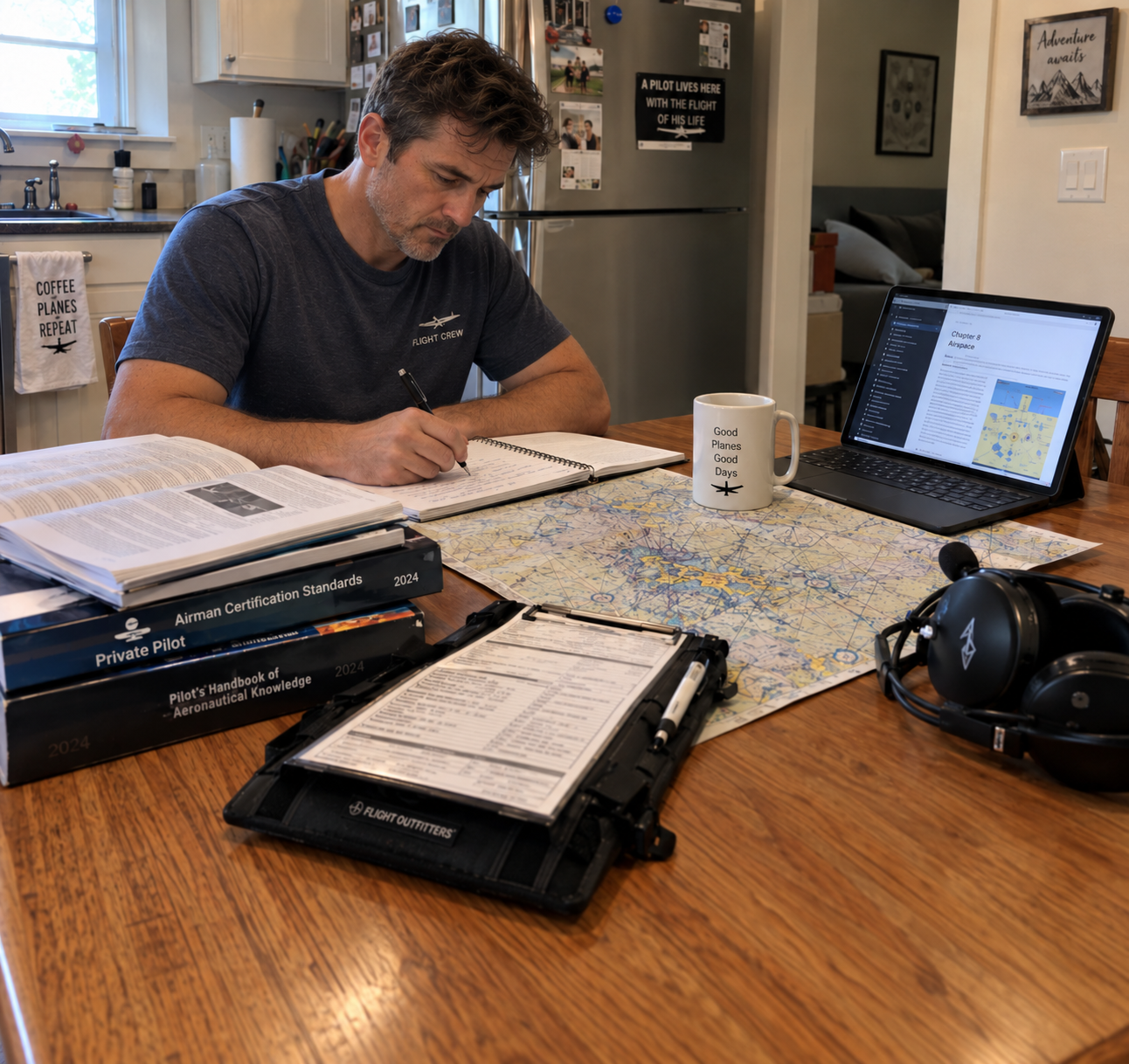
Nobody really talks about what it's like to start flight training when you're not 19 with unlimited free time.
If you're coming to your Private Pilot certificate later, in your 40s, 50s, or 60s, the training itself works differently than most YouTube channels would have you believe. And in more ways than most people realize, it works in your favor.
I've been training Private Pilot applicants for over a decade.
A significant portion of the students I work with are professionals in their 40s and 50s, pursuing flying as a hobby they've wanted for years. Some of them are semi-retired. Some are running businesses. Some just decided at 52 that they weren't going to keep telling themselves they'd fly "someday."
Here's what I've learned watching them go through the certificate.
You'll Question Whether You're Too Old. You're Not.
The airplane doesn't know how old you are. People earn Private Pilot certificates in their 40s, 50s, 60s, and well beyond every week. The FAA doesn't age-gate flight training.
What matters is showing up consistently — and consistency is something most working adults have already gotten good at through their careers. It's the 22-year-old with three jobs and inconsistent access to an airplane who tends to stall out, not the 55-year-old CFO who blocks Saturday mornings for training the same way they'd block a board meeting.
Age is not the barrier you might be worried it is. What actually decides who finishes has almost nothing to do with age.
Your Time Is Tighter. That's an Advantage — If You Use It Right.
Younger students often have more raw hours available to throw at training. What they usually don't have is a system for using those hours efficiently.
You do. You've spent twenty or thirty years learning how to prioritize, how to filter signal from noise, and how to get the highest return out of limited time. That's a professional skill, and it maps directly onto how successful Private Pilot candidates prepare.
The mistake most older students make isn't studying too little. It's studying without a system — flipping between the PHAK, YouTube videos, ground school clips, and practice tests without a clear picture of what they actually already know versus what they're just recognizing.
When your time is $200 an hour of Cessna rental plus your CFI's rate, wasting study hours has a real cost. The students I've seen finish efficiently are the ones who treat their ground study the way they treat their day job — structured, measurable, and focused on what still needs work rather than what they've already got.
The Ground Portion Is Where Older Students Actually Win
Here's the thing that surprises most students who start training later.
The oral exam doesn't care how fast your reflexes are. It doesn't reward hand-eye coordination. It rewards preparation — the ability to explain aviation concepts at ACS depth, out loud, in front of a DPE, without notes.
That's a preparation skill, not a physical skill. It's exactly the kind of task that professional adults are typically better at than younger students, because they've been preparing for high-stakes situations their entire careers.
If you're worried about the flying portion, you probably shouldn't be. Consistent lessons will get you there. The place to focus your worry — and your study effort — is the ground portion. Airspace at oral depth. Weather scenarios. Aeromedical topics. The regulations that apply to a specific flight, not just in the abstract. Aircraft systems, explained the way a DPE will want to hear them.
That's the mountain most students underestimate. It's also the mountain that rewards exactly the kind of methodical, structured preparation you're already good at.
What "Efficient Study" Actually Looks Like for a Working Adult
Efficient study for a Private Pilot certificate is not the same thing as reading more.
It's about knowing — precisely — which of the seven ACS knowledge areas you can already explain confidently and which ones still have gaps. Then spending your limited study time only on the gaps.
Most students can't do that easily because they don't have a system for measuring what they actually know versus what they recognize. Reading a chapter feels productive. Watching a ground school video feels productive. Neither of those actually tells you whether you could produce the answer out loud on the checkride.
The students I've seen finish efficiently — especially the working professionals — figured out early that they needed a way to separate "solid" material from "still needs work" so they could focus their study time on what actually needed attention.
That's the entire game for a busy adult student. Not more hours. Better-directed hours.
That's the Reason We Built the Deck
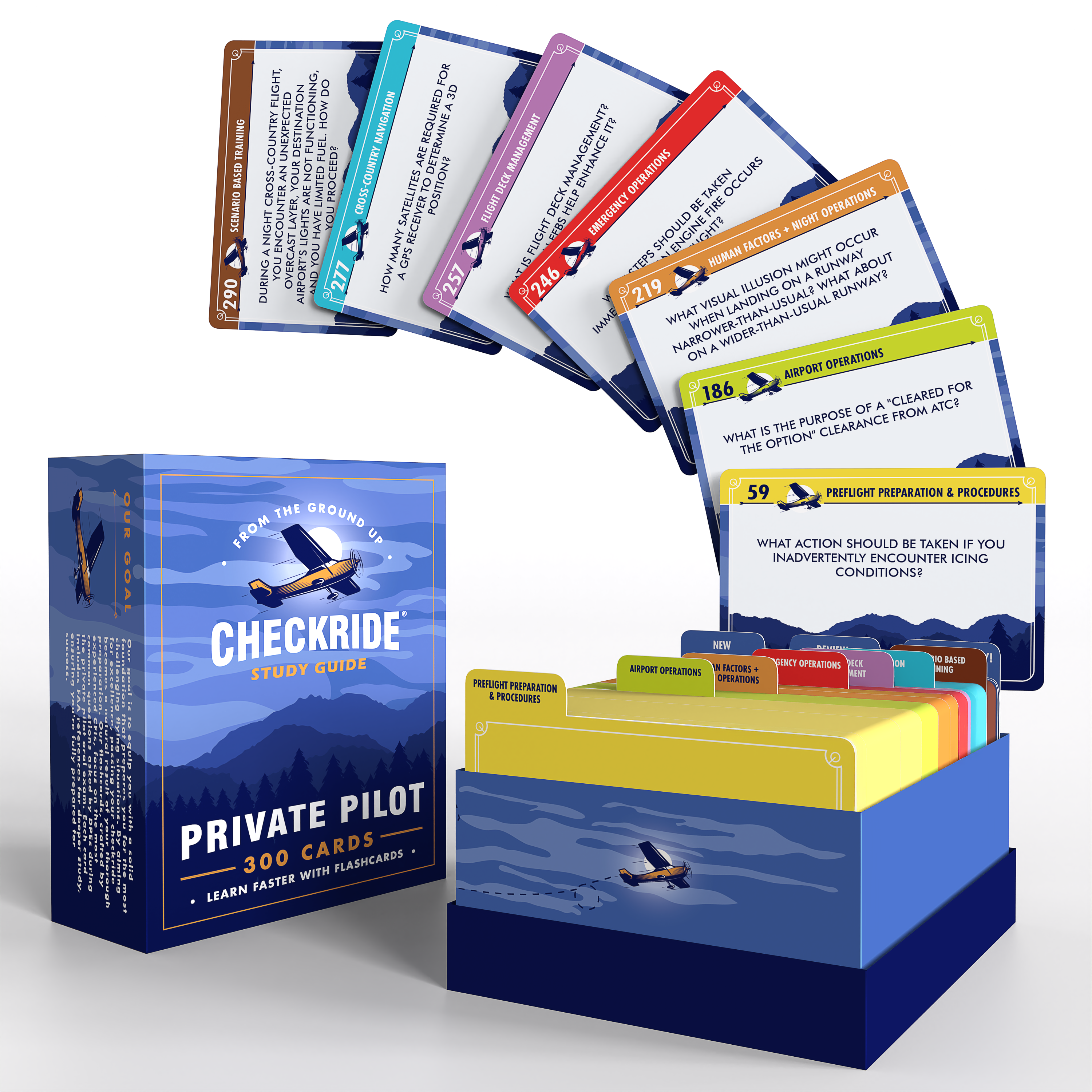
The Checkride Study Guide Private Pilot Flashcards are 308 physical cards, written and reviewed by CFIs, organized into the seven ACS knowledge areas the Private Pilot oral tests.
Every card asks a direct or scenario-based question. Every answer cites the FAA reference where the material lives. The scenario cards — the ones structured the way a DPE actually asks — are the ones that separate "I recognize this" from "I can explain this."
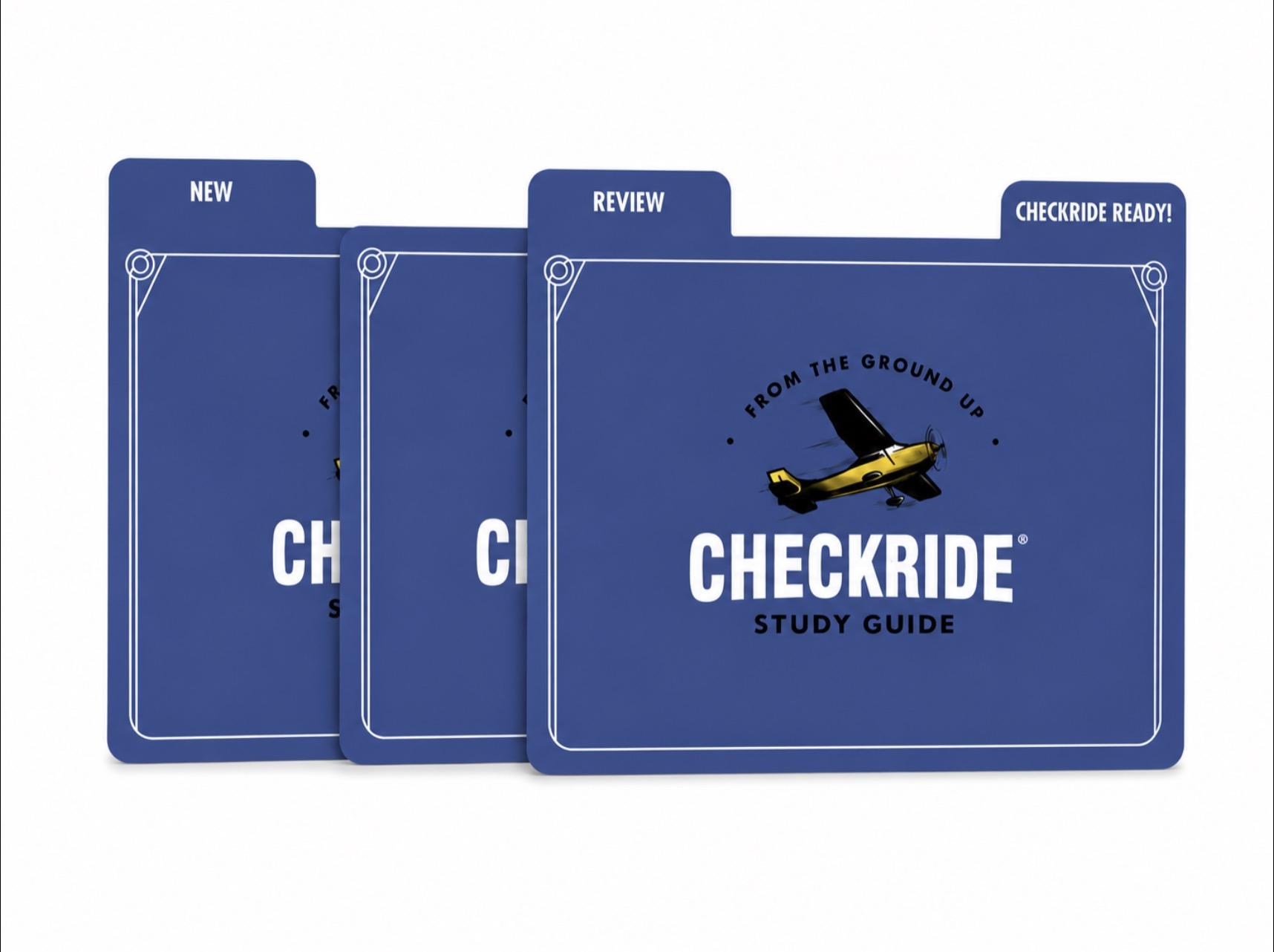
New → Review → Checkride Ready
Every card starts in New. You pull one, read the question, and say the answer out loud before you flip it.
If you got it clean — accurate, at the depth a DPE would want — the card moves to Review. If you nailed it in Review the next session, it moves to Checkride Ready. If you missed it, or you knew it but couldn't produce it cleanly, it stays where it was.
The whole deck is a physical picture of your knowledge gap. The cards in New are what you don't have yet. The cards in Review are what's coming along. The cards in Checkride Ready are what you can explain to a DPE tomorrow if asked.
You aren't studying "everything" anymore. You're studying whatever isn't yet in Checkride Ready — and by the last week before your checkride, that's usually a small stack of specific weak topics rather than a mountain of undifferentiated material.
The stack stops piling up because you can see it. That's the entire trick.
Costs less than one flight lesson
Lifetime Satisfaction guarantee
What Adult Private Pilot Students Are Saying
David W, Verified Customer
I use the cards as a measurement for my studying. If I can't answer a question it remains in front of the deck. If I can answer the question it goes to the back. It's a good measure for what I need to keep studying — all in one place, not scattered all over.
Misael, Verified Customer
I take long road trips with my family and with the flashcards we can transform them into checkrides. My wife acts as the DPE and fires questions away. We decide together if my answers are satisfactory or need review.
Jeff V, Verified Customer
The color-coding made it easy to break topics down… and the references to FAR/AIM were super helpful.
Dylan Meade, Amazon Customer
These cards break everything down in a way that’s structured, clear, and practical, not just memorization. The explanations go beyond one-line answers, they actually help you understand the ‘why’.
What's In the Box?
-
308 physical Private Pilot flashcards written and reviewed by CFIs
-
7 color-coded ACS sections
-
Direct-recall and scenario-based questions
-
ACS task codes and FAA references on every card
-
New / Review / Checkride Ready progress dividers
-
Premium rigid storage box
-
Free CFI email support while you study
-
Satisfaction guarantee
Why Not Just Make Your Own?
You can. Plenty of students use Quizlet, Anki, or paper cards they wrote themselves.
Two tradeoffs are worth naming.
The first is time. Building 300+ verified cards that cover the whole Private Pilot ACS with the right FAA reference on each is a weekend or two of work before you've studied a single one. Most students who commit to this end up doing it partially and quitting halfway — which is one more way the stack starts to pile.
The second is verification. Crowd-sourced Quizlet decks for Private Pilot are frequently out of date. Old regulations. Wrong minimums. Missing sources. If you're going to trust flashcards for a checkride, the answers on the back have to be correct.
At $64.99, the deck costs less than one hour with a CFI at most flight schools. It's the difference between spending your weekend building a system and spending your weekend using one.