Why Most Student Pilots Don't Quit Because They Can't Fly
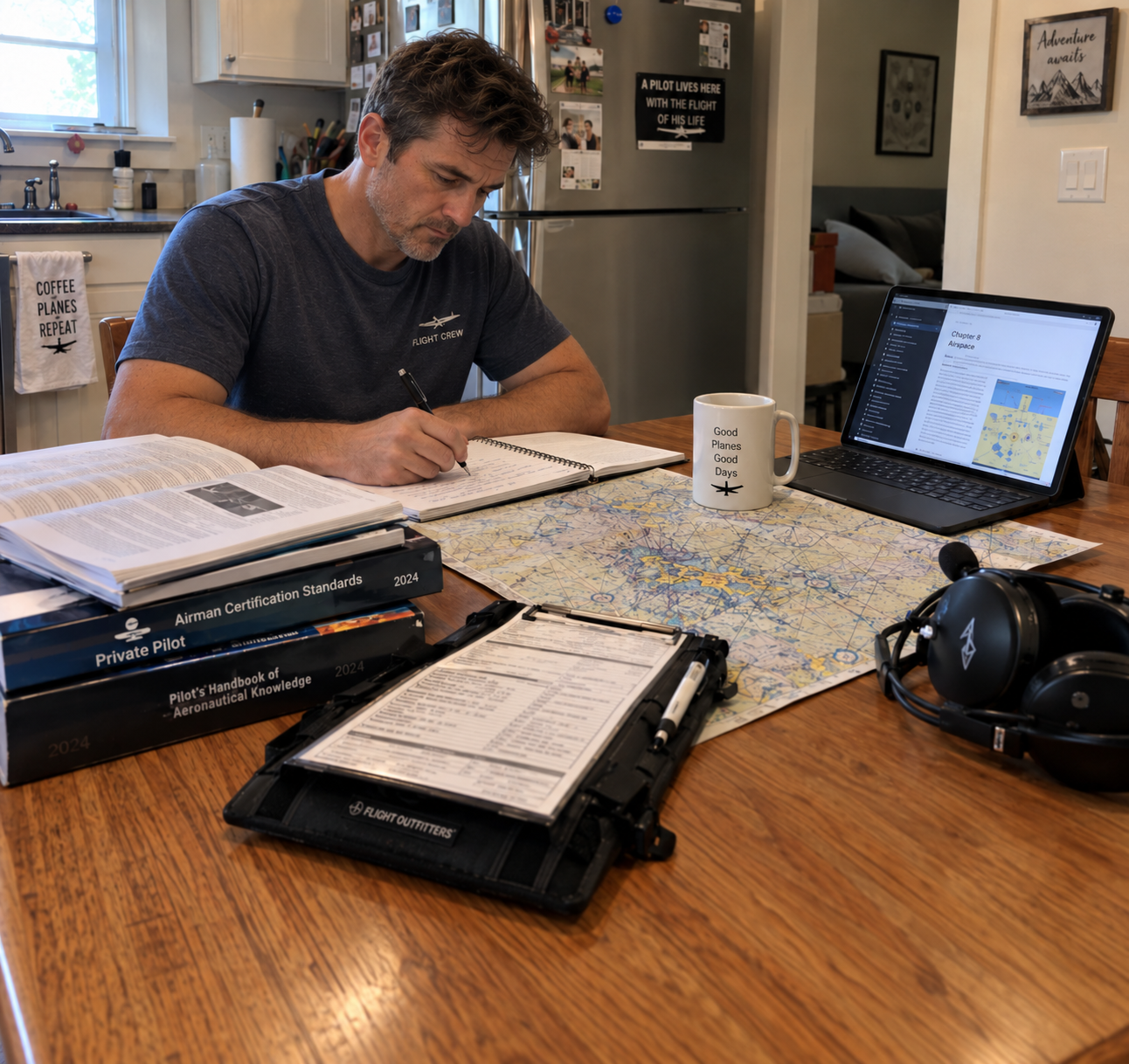
Most student pilots who start their Private Pilot training don't finish.
Very few of them quit because they couldn't fly.
I've been training Private Pilot applicants for years, and I've watched dozens of students walk away from the certificate. Some of them were naturally talented in the airplane. Some of them had every advantage, money, time, a solid CFI, good weather. They still quit.
The reason is almost never the flying.
Here's what I actually watch happen.
A student is 25 hours in and flying well. The stick-and-rudder skills are progressing. The landings are getting consistent. The CFI is happy.
Then life gets busy. Weather cancels two lessons. A work trip cancels a third. Three weeks pass. The student comes back and spends the first 20 minutes of the next lesson relearning what they had solid a month ago. The CFI patiently walks them back through it. They fly. It's fine.
But something quiet happened during those three weeks. The ground material didn't get touched.
Airspace, weather, sectionals, regulations, aeromedical, systems, the entire body of knowledge that has to be at oral-exam depth by the time the checkride comes, just sat there. The student didn't lose what they knew. They just didn't build on it. And when the flight lessons resume, the ground material takes a back seat again because the flying is the fun part.
That's how the pile starts.
The Written and the Oral Aren't Difficult. They're Deferred.
By the time most student pilots realize the ground portion is a real body of work, they're already behind on it.
The written test alone requires understanding of nine ACS knowledge areas at a depth most students never reach on their own. The oral requires the ability to explain any of those topics out loud, cold, without notes, in front of a DPE. That's not the same skill as passing a multiple-choice practice test, it's an entirely separate discipline that has to be practiced separately.
And it doesn't get practiced during flight lessons.
Your CFI can catch a flare that's too high. They can talk you through a crosswind landing. They cannot, in the middle of a Wednesday lesson, cover every ACS knowledge topic to the depth a DPE will require months from now. That work belongs to you, on the ground, between lessons.
Most students underestimate how much work that is. By the time they realize what it takes, the mountain is already tall enough that they stall out, not because it's actually hard, but because it feels too late to start.
What the Mountain Actually Looks Like
Here's what I mean by "the mountain," in specifics.
The airspace section of the ACS asks you to explain, out loud, with a sectional in your hand, every class of airspace, the equipment requirements at every altitude, the communication procedures, and what happens when a Class D tower closes and the airspace changes. Most students memorize the diagrams and can't hold a conversation about it.
The weather section asks you to decode METARs and TAFs, then apply them to a specific flight. Not the definitions. The decisions.
The aeromedical section covers the four types of hypoxia, six named vestibular illusions, the FAA rules on medications, and the specific mechanism by which carbon monoxide poisons a pilot at altitude. Students skim this section harder than any other.
Aircraft systems requires you to explain how your specific airplane's fuel system, electrical system, and pitot-static system work, and what happens when each fails.
Regulations. Human factors. Navigation. Emergency procedures. Airport operations.
Each of those is a stack of ACS knowledge topics that has to move from "I've seen this" to "I can explain it cold" before the checkride. And every week you don't work on it, the stack sits.
That's the Reason We Built the Deck
The Checkride Study Guide Private Pilot Flashcards are 308 physical cards, written and reviewed by CFIs, covering the 7 ACS knowledge areas the Private Pilot oral tests. Every card asks a direct or scenario-based question. Every answer cites the FAA reference where the material lives.
The number of cards isn't the point. The sort system that goes with them is.
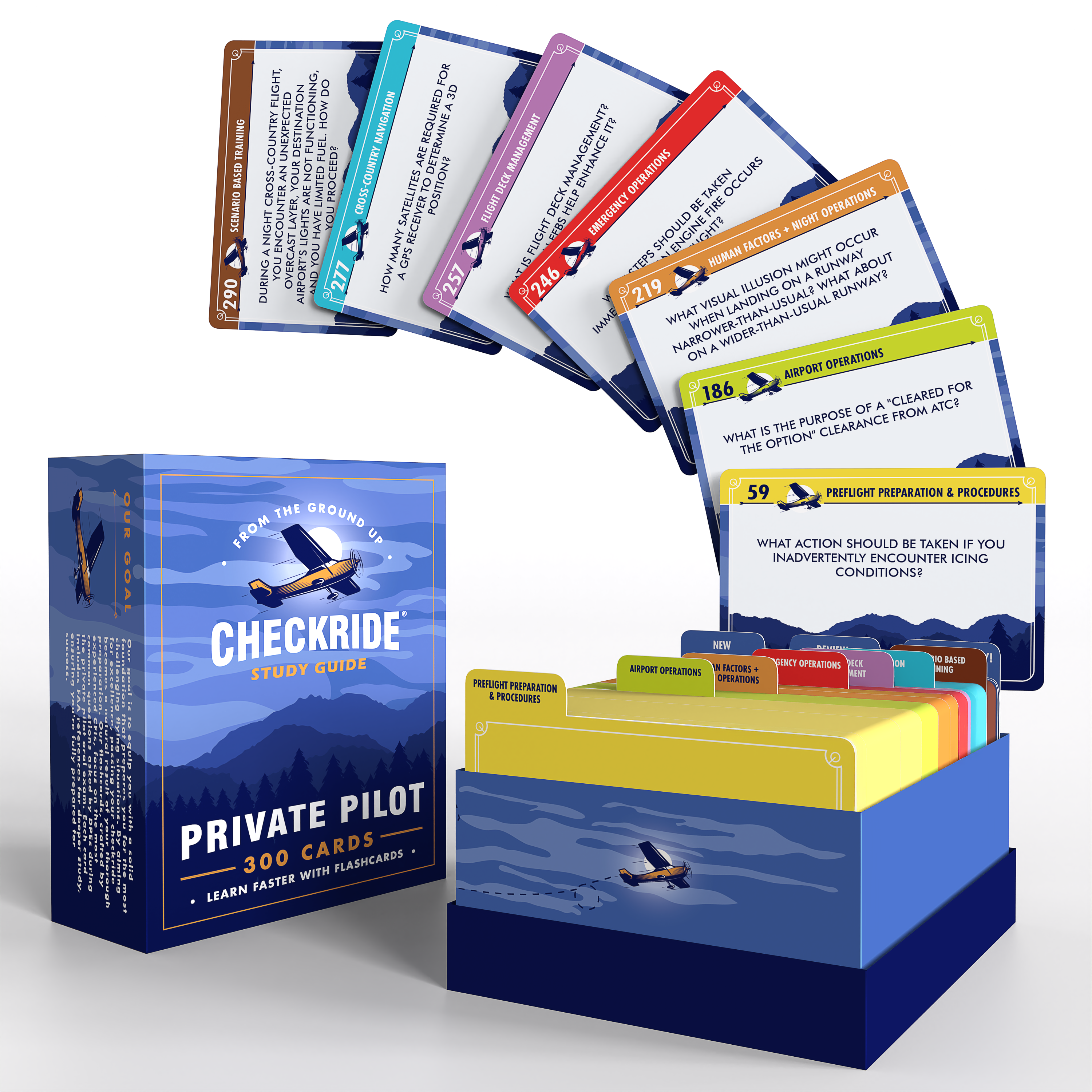
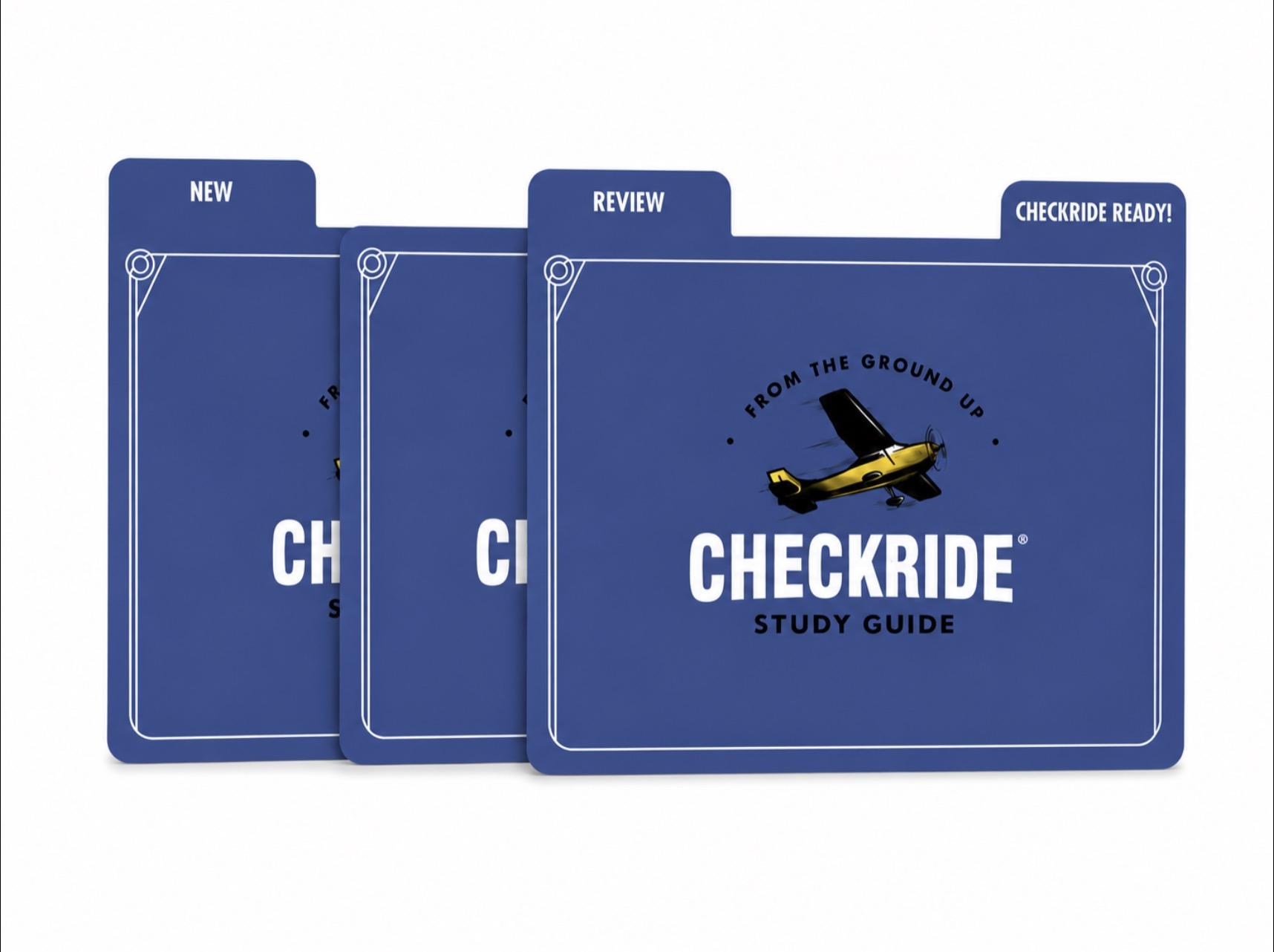
New → Review → Checkride Ready
Every card starts in New. You pull one, read the question, and say the answer out loud before you flip it.
If you got it clean — accurate, at the depth a DPE would want — the card moves to Review. If you nailed it in Review the next session, it moves to Checkride Ready. If you missed it, or you knew it but couldn't produce it cleanly, it stays where it was.
The whole deck is a physical picture of your knowledge gap. The cards in New are what you don't have yet. The cards in Review are what's coming along. The cards in Checkride Ready are what you can explain to a DPE tomorrow if asked.
You aren't studying "everything" anymore. You're studying whatever isn't yet in Checkride Ready — and by the last week before your checkride, that's usually a small stack of specific weak topics rather than a mountain of undifferentiated material.
The stack stops piling up because you can see it. That's the entire trick.
Costs less than one flight lesson
Lifetime Satisfaction guarantee
What people are saying about us...
David W, Verified Customer
I use the cards as a measurement for my studying. If I can't answer a question it remains in front of the deck. If I can answer the question it goes to the back. It's a good measure for what I need to keep studying — all in one place, not scattered all over.
Misael, Verified Customer
The flashcards are incredibly well-organized and concise, making it easy to drill the key concepts and procedures.
Jeff V, Verified Customer
The color-coding made it easy to break topics down… and the references to FAR/AIM were super helpful.
Dylan Meade, Amazon Customer
These cards break everything down in a way that’s structured, clear, and practical, not just memorization. The explanations go beyond one-line answers, they actually help you understand the ‘why’.
What's In the Box?
-
308 physical Private Pilot flashcards written and reviewed by CFIs
-
7 color-coded ACS sections
-
Direct-recall and scenario-based questions
-
ACS task codes and FAA references on every card
-
New / Review / Checkride Ready progress dividers
-
Premium rigid storage box
-
Free CFI email support while you study
-
Satisfaction guarantee
Why Not Just Make Your Own?
You can. Plenty of students use Quizlet, Anki, or paper cards they wrote themselves.
Two tradeoffs are worth naming.
The first is time. Building 300+ verified cards that cover the whole Private Pilot ACS with the right FAA reference on each is a weekend or two of work before you've studied a single one. Most students who commit to this end up doing it partially and quitting halfway — which is one more way the stack starts to pile.
The second is verification. Crowd-sourced Quizlet decks for Private Pilot are frequently out of date. Old regulations. Wrong minimums. Missing sources. If you're going to trust flashcards for a checkride, the answers on the back have to be correct.
At $64.99, the deck costs less than one hour with a CFI at most flight schools. It's the difference between spending your weekend building a system and spending your weekend using one.