

Remote Pilot Part 107 Flashcards
Remote Pilot Part 107 Flashcards
Couldn't load pickup availability
-
Ordered
- - -
Order Ready
- - -
Delivered
Pass Your Part 107 on the First Try - Or We Pay Your $175 Test Fee.
$175 Pass Guarantee: study the deck, complete the practice exam, and take the test within 60 days of purchase. If you do not pass your first attempt, send us your score report and matching photo ID and we'll pay your $175 test fee. Take your retest within 14 days and we pay that too.
These 300+ Part 107 flashcards are designed to help you pass by focusing only on what the FAA actually tests. Each card targets a specific knowledge area, is written in plain English, and is built for fast retention using proven active-recall study methods.
100% Satisfaction Guarantee or your money back
- Practice exam included
- FAA references throughout
- Study Strategy for Success: Our approach ensures better retention of key concepts, helping you feel confident and prepared.
- FAA References Throughout: Each card provides FAA references for further exploration and study.
- FREE 24/7 flight instructor email access
Less Than Half the Test Fee
- The FAA knowledge testing centers charge $175 for the initial Remote Pilot knowledge test, these cards are less than half that cost!
- Find your weak areas before one unsuccessful attempt costs more than the entire deck.
Why These Flashcards Work
Most Part 107 students struggle because they spend time on:
- Dense FAA PDFs
- Random YouTube videos
- Practice quizzes without clear explanations
Our flashcards eliminate the guesswork.
By combining active recall, clear explanations, and exam-aligned organization, you spend less time studying and walk into the exam confident and prepared.
No fluff. Just what the FAA actually tests.
Study by Section:
- Regulations & Part 107 Privileges
- Airspace & Sectional Charts
- Weather Reports & Weather Sources
- Weather Effects on UAS Performance
- Loading & Performance
- Emergency Procedures
- Crew Resource Management (CRM) & ADM
- Radio Communications & Airport Operations
- Physiological Factors & Human Performance
- Maintenance & Preflight
- Practice Exam Questions
Get the confidence and knowledge you need to pass on your first attempt!
Who this is for:
- First-time Part 107 test takers
- Retakes who want a structured system
- Drone business owners / commercial operators
- Anyone who wants a faster, clearer way to pass
Also included:
- New, Review, and Written Ready progress dividers — sort every card into what you know, what needs more work, and what is test-ready
- FAA reference on every answer side — exact regulation, advisory circular, and FAA publication cited on every card
- One concept per card — a direct Part 107 knowledge question on the front, a plain-English accurate answer on the back
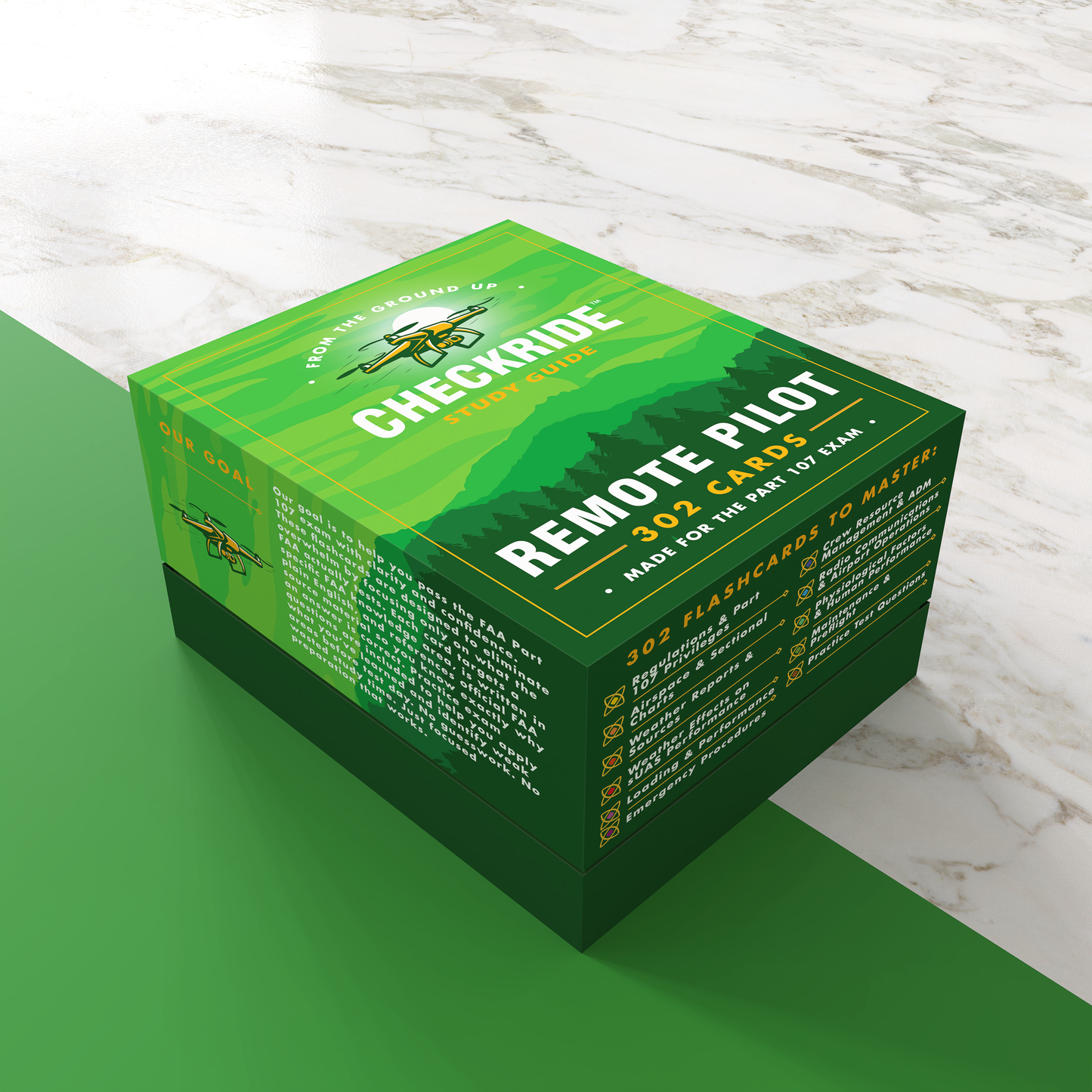
- Premium rigid box — organized, durable, built for daily study sessions wherever you work
- 100% Satisfaction Guarantee

Remote Pilot Part 107 Flashcards


Written at the instructional level
Every card was written by Flight Instructors who have prepared applicants for the part 107 written test as well as have years of manned aviation experience. The questions reflect how the FAA asks them, at the depth and instructional application required. The cards are complete and accurately sourced.


Top 3 Most Difficult Topics Tested
Learn Faster With Flashcards

New to Aviation? Start From the Ground Up.
You do not need a traditional pilot background to begin preparing for Part 107.
Work through airspace, sectional charts, weather, regulations, airport operations, and UAS performance one focused question at a time. Plain-English answers and FAA references help you build the aviation foundation needed before moving into mixed practice questions.

Turn Your Drone Skills Into a Professional Credential
Whether you are preparing for real-estate photography, mapping, inspections, construction, media production, or another professional drone application, Part 107 knowledge is part of operating responsibly and professionally.
Use the deck to organize your preparation, understand the regulations behind commercial operations, and identify weak areas before test day.

Failed the test and preparing for a retake?
An unsuccessful attempt tells you that part of your preparation process needs to change.
Use the deck’s color-coded sections and progress dividers to isolate weak subjects, repeat missed concepts, and review the supporting FAA sources before taking another mixed practice exam.
- Keep unfamiliar questions in New
- Move developing subjects into Review
- Move consistently correct answers into Written Ready
Focus your remaining study time on what still needs work instead of restarting everything from the beginning.

Already a Pilot? Focus on What Is Different Under Part 107.
Your aviation background gives you a head start, but Part 107 introduces regulations, responsibilities, and operating requirements specific to small unmanned aircraft.
Use the deck to focus your review on:
- Part 107 privileges and limitations
- Remote-pilot responsibilities
- Small UAS operating requirements
- Airspace considerations
- Weather effects on UAS performance
- Crew resource management and decision-making
- Maintenance and preflight responsibilities
Spend less time relearning general aviation concepts and more time reviewing what applies specifically to remote-pilot operations.

Build Part 107 Knowledge Across Your Team
Use the deck to support employee onboarding, structured review, and instructor-led knowledge checks for commercial drone operations.
The 11 color-coded sections make it easy to:
- Assign specific topics to employees
- Review operating regulations
- Reinforce airspace and weather knowledge
- Discuss emergency procedures and human factors
- Identify areas requiring additional training
- Create a more consistent foundation across operators
The deck does not replace your company procedures, recurrent training, or compliance program. It gives your team a structured physical resource for reviewing foundational Part 107 knowledge.

Study Strategy
Start every card in the New section. When you can answer it without flipping the card, move it to Review. Once you can explain the complete answer accurately, confidently, and without prompting, move it to Written Ready.
Why Remote Pilots Learn Faster with This Deck

Plain-English questions. Accurate answers. Exact FAA citation.
Every card was written by aviation professionals who know and teach Part 107 and current FAA regulations. Questions are framed the way the FAA tests them. Answers are complete, accurate, and cited to the exact regulation or publication.
Frequently Asked Questions
How many cards are included?
How many cards are included?
302 physical flashcards in a premium rigid box, organized into 11 color-coded knowledge sections covering every area the FAA Part 107 Knowledge Test tests.
Is this for the initial Part 107 test, the recurrent test, or both?
Is this for the initial Part 107 test, the recurrent test, or both?
Both. The cards cover the complete Part 107 ACS knowledge areas applicable to both the initial Remote Pilot Knowledge Test and the Recurrent Knowledge Test. For recurrent prep, sort through the deck, cards that move to Test Ready quickly are solid; cards in Review are where knowledge has drifted.
I am already using an online Part 107 prep course. Do I need these too?
I am already using an online Part 107 prep course. Do I need these too?
Online courses build familiarity with the material and often include practice test questions that build recognition. These cards build retrieval, producing the answer before seeing the options. Both skills are useful for the Part 107 test. Most candidates who use physical cards alongside an online course report feeling more confident on questions where the FAA phrases a topic differently than the prep course did.
I have a pilot certificate. Do I still need to study for Part 107?
I have a pilot certificate. Do I still need to study for Part 107?
If you hold a pilot certificate with a current flight review, you are eligible for an expedited Part 107 process, but you still need to understand Part 107-specific regulations, sUAS operational requirements, and the remote identification rules that apply to commercial drone operations and do not appear in the pilot ACS. The regulatory and operational sections of this deck cover the Part 107-specific content that your pilot certificate does not address.
What is the hardest section of the Part 107 test?
What is the hardest section of the Part 107 test?
Airspace and weather interpretation are the two most commonly failed topic areas. Both require specific knowledge that non-pilot drone operators often encounter for the first time. The airspace section covers classification, entry requirements, and sectional chart reading for sUAS operations. The weather section requires reading and interpreting actual METAR and TAF format — not just understanding what weather is. Both sections have dedicated color-coded sections in this deck.
Does the card count include a practice exam?
Does the card count include a practice exam?
Yes. One of the 11 sections is a Practice Exam Questions section containing 60 representative knowledge questions across all topic areas. These are designed for final review before the test- after you have worked through all 10 knowledge sections.
Does the card count include a practice exam?
Does the card count include a practice exam?
Yes. One of the 11 sections is a Practice Exam Questions section containing 60 representative knowledge questions across all topic areas. These are designed for final review before the test- after you have worked through all 10 knowledge sections.
How long does it take to prepare for the Part 107 test?
How long does it take to prepare for the Part 107 test?
Most candidates are adequately prepared after 2 to 4 weeks of consistent study approximately 15–20 hours of total study time. Working through one card section per day in 20–30 minute sessions covers the full deck in 11 days. Then spend remaining time on Review cards before the test.
